FINDING ANSWERS

FAQs

General Questions

From the Greek “ortho” meaning straight and “odontos” for teeth, orthodontics is a specialty of dentistry aimed at the diagnostic, prevention and treatment of dento-facial anomalies and dental malpositions.

The technical term to describe these problems is “malocclusion”.

Practicing orthodontics requires professional aptitudes in diagnostics, treatment planning, insertion, use and control of different corrective appliances used to align teeth, lips and jaws, all contributing to dento-facial harmony.

Practically anyone with occlusal problems can benefit from orthodontics. If the tooth supporting tissues (gingiva and bone) are healthy, there are usually no contra-indications to undertake orthodontic correction.

Orthodontists are dentists who have gone on and trained additionally (or specialised) for two to three years. Teeth, and sometimes entire facial structures, are permanently changed by orthodontic treatment. It is important that the treatment be appropriate and properly completed. Orthodontic specialists have extensive and specialized training that enables them to provide their patients with professional, personalized treatments.

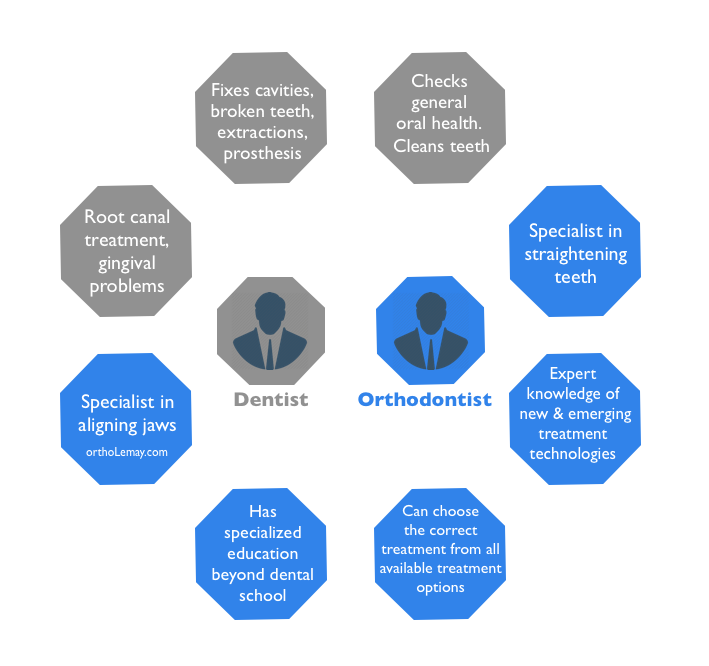
A dentist is similar to your family doctor — great for check-ups and filling cavities. An orthodontist is a specialist who has two to three years of additional education, and is an expert in straightening your teeth and choosing the treatment option that’s best for you.


1. Whilst having beautiful straight teeth is important, even more important is the need to alleviate any potential health problems associated with the teeth or jaw.  Crooked teeth or jaw problems may contribute to improper cleaning of teeth, leading to tooth decay and, possibly, gum disease or total tooth loss.  Orthodontic problems that go untreated can lead to chewing and digestion difficulties, speech impairments, and abnormal wear of tooth surfaces.  Over time, excessive strain on gum tissue and the bone that supports the teeth can affect the jaw joints leading to problems such as headaches or face and neck pain.

2. Self Esteem. Everyone wants a great smile, and your orthodontist is a specialist in making your smile the best it can be. Straight teeth not only look good, they also give you a good bite. A healthy smile is always in style! Hiding your teeth or not smiling makes people look at you and incorrectly assess you. Be yourself – smile when you want to.

3. You never get a second chance to make a first impression! A great smile helps you feel better and more confident. It can literally change how people see you – at work and in your personal life. With so many people competing for jobs or promotions and with everyone similarly qualified, our world is about how we present ourselves – how others see us. Be the best you can be and flash that confident smile.

The American Association of Orthodontics recommends that children get an orthodontic evaluation no later than age 7.  Though orthodontic treatment can be done at any age, timely treatment ensures maximum dental health.

There is no age limit to consider orthodontics.

Even if the majority of orthodontic patients are children or adolescents, more than 25% of Canadians under orthodontic care are adults. In our practice, this proportion is even greater at about 50%.

We regularly and successfully treat patients between 40 and 70+ years of age. The oldest patient we saw started at 82!

The basic biological process allowing the teeth to move is the same for all healthy individuals, regardless of their age.

In adults, the absence of growth may make it necessary to use different treatment modalities or to have different treatment objectives than with a growing child.

Technology is constantly changing and in the past few years there have been many advances in orthodontics which are particularly suited for adults by making treatment more efficient, accessible and comfortable than ever before.

It is never too late to improve your dental condition with orthodontics.

Most people in our society can benefit from orthodontic treatment. Whether it is a crooked tooth or a bad bite, Dr. Armogan can assess your case and advise you of the benefits of treatment and the potential harm of not treating the problem. Young or old, we use many different types of appliances to fix bad bites and give you that fantastic result we are so famous for.

Phase I or Interceptive Treatment usually starts while the child has most of their baby teeth and a few of their permanent front incisors. This stage in development is usually about the age of 7. The goal of Phase I treatment is to intercept a moderate or severe orthodontic problem early in order to reduce or eliminate it. These problems include skeletal dysplasia, cross-bites and crowding. Phase I treatment takes advantage of the early growth spurt and turns a difficult orthodontic problem into a more manageable one. This usually helps reduce the need for extractions or surgery and delivers better long term results and treatment options. Most Phase I patients require a Phase II treatment in order to achieve an ideal bite.

Phase II treatment usually occurs a number of years later. Usually we are waiting for 12-16 more permanent teeth to erupt before Phase II begins. This most commonly occurs at the age of 10 or 13. The goal of Phase II treatment is to achieve an ideal occlusion with all of the permanent teeth.

Phase I can be thought of as doing the work on the foundation of a building while Phase II is putting up the structure.

This is not recommended. If your child needs Phase I treatment this usually means that he/she has a difficult problem that requires attention now.

If no orthodontic action is taken, treatment options become limited, more difficult, and the long-term stability may be compromised.

In addition, it may lead to extractions, oral surgery, increased treatment time and increased costs.

“Malocclusion” is a technical term for crooked, crowded, mal-aligned or protruding teeth which do not fit together properly. Literally, the word is broken down as ‘mal’ for ‘bad’ and ‘occlusion’ for ‘bite’ or “bad bite.”

The term “occlusion” refers to the relationship of the teeth with one another when the jaws are closed. For a “bite” to be functional and aesthetic, not only must there be a precise arrangement between the teeth but there must be a harmonious relationship between the jaws as well.

Any deviation from this “ideal” relationship is considered a “malocclusion”. It refers to any inadequate relationship between the teeth and/or jaws.

The most common malocclusions have crooked, crowded, rotated teeth, excessive overbite, teeth that are “sticking out”, teeth that do not touch one another when biting, “scissor bites”, etc

Most malocclusions are inherited. These include crowding of teeth, too much space between teeth, extra or missing teeth, cleft palate and a variety of irregularities of the jaws and face.

Technological Advances in Travel. In the good old days, if you were born in North Germany you pretty well met and married someone from North Germany. Today, thanks to advances in technology, it is not uncommon to take a picture of a group of students and see people of all types from all places. Each region has variations in size and structure and each race/culture has its own variations. With such varied genetics we have different size and shape upper and lower jaws coming from our ancestors and presenting in our kids which leads to even more malocclusions.

People in ‘developed societies’ are eating softer foods! Generation after generation the body is evolving and compensating for this by making the jaws smaller and smaller. Unfortunately, the same number of teeth are now trying to fit into the smaller jaws! The body is trying to compensate and so we are now also seeing many people with smaller teeth (usually the lateral incisors on top which is the second tooth from the front and is sometimes ‘peg’ in shape) or missing teeth. Unfortunately, the teeth the body has chosen to eliminate don’t mesh with our sense of fashion!

Many people may be familiar with the work of Dr. Weston Price, a U.S. dentist. In the 1930’s he travelled the world and studied all the “primitive” cultures of the world. At that time there were many pockets of people not exposed to western civilization and in particular, the Western diet of processed foods such as white flour and sugar.

He was very interested in the effect of diet on growth and development. He studied groups of Inuit, Pacific Islanders, Australian Aborigines, New Zealand Maori, Swiss Highlanders and South American Indians and he made some very astute observations. Those not exposed to the “Western” diet as children universally had broad, attractive faces and wide dental arches with beautifully aligned teeth and no tooth decay.Within one generation of the mothers and children consuming white flour, sugar and other nutrient-poor foods, the faces became narrower, the dental arches irregular with crowded teeth and they began to develop tooth decay. This Dr. Weston Price put down to poor nutrient absorption interfering with growth and tooth strength. He also posited that this change in dietary habits possibly encouraged the development of allergies and airway obstruction causing mouth-breathing, a change in tongue posture and the associated development of a long and narrow face.

No, this is very unlikely

In most people, once the first permanent molars have erupted (at around age 6-7), the available space for the anterior (front) teeth will not increase, even in the presence of growth. As a child gets older, the jaw gets longer but it has to add in additional teeth. Remember, a child has 20 teeth and an adult has 32 teeth. So, even though the parking lot is getting bigger as they grow, so many more ‘cars’ are coming to the event! As such, once you see crooked teeth in a child, it will not get better on its own.

While the jaw does get bigger in the back to let in the additional teeth in going from a child to an adult, once we turn 18 the lower jaw actually changes shape as we get older and the space will usually decrease – this is why so many older people have very crooked front teeth, especially on the lower jaw.

Studies have demonstrated that most occlusal and dental problems have a tendency to deteriorate with time if they are not treated

No, this is highly unlikely

Although growth helps the orthodontist in treating skeletal imbalances (jaw size discrepancies), growth alone will not solve the problem.

Think of it like this – your right arm and you left arm grow equally. So do your upper and lower jaws – they are supposed to keep pace with each other. If you have an overbite, the lower jaw is not suddenly going to speed up to catch up with the upper jaw. However, using orthodontic appliances during treatment allows us to optimally utilize the growth potential to try to obtain better jaw relationships.

In certain cases where the growth pattern is really unfavourable or abnormal (such as when the lower jaw bites in front of the upper jaw), any supplemental growth may in fact worsen the problem. It is therefore important that such problems be evaluated early by an orthodontist.

Treatment time will vary depending on what we are trying to accomplish but generally will be affected by:

  1. Complexity
  2. Age
  3. Cooperation

As a general rule, children and teenagers take about six months less than adults.

Any breakage you have during treatment will significantly increase your treatment time.

Failure to comply with instructions and not wear or use accessory devices/elastics will significantly increase your treatment time.

Continuation of habits during treatment will also negatively impact on treatment time and results.

Before Treatment

Absolutely NOT!  In fact, while many dentists do refer patients to our practice, our patients are usually our biggest referrers.  Additionally, many of our patients simply notice something wrong with their smiles and book a consultation with us.

If you would like to know how you or your child can benefit from orthodontics, you can communicate directly with us by:

• Phone: (246) 427-2237 or easier to remember as 4-BRACES

• Email: braces@caribsmiles.net

• Using the online Consultation request form

This would provide us with the basic information required to plan your first visit.

The goal of this first visit is to evaluate your dental condition (or that of your child) and to either make recommendations about preventing problems from appearing or intercepting problems that are already developing.

We will try to answer all of your questions and tell you if treatment is indicated and if so, what are the treatment options their duration and cost.

Whilst we do try to schedule as many of your appointments after school as possible we reserve this time for shorter procedures like your adjustments.

Longer procedures are usually done during school hours so as to give as many people as possible an opportunity to be treated after school hours.

With our advanced braces technology, you will likely be visiting us every 2 to 3 months versus the older technologies that demand you be seen every month.

Our operating hours have been designed with you in mind so it is likely that you can find a time that will minimally impact your lifestyle.

With our advances braces system you will likely be visiting us every eight to twelve weeks! That’s just four to six times a year!

There are times, depending on your treatment, that Dr. Armogan will request you come in sooner but this is usually if he needs to keep an eye on something.

Many of the kids in expanders will be visiting us every two weeks for the first couple of appointments just to be sure all is going well.

After treatment is completed at our office you may need to consult with your dentist about additional cosmetic or functional needs.

Many people today have small lateral incisors (the second tooth from the front) and will need to have bonding (or veneers) on these after the orthodontic treatment is completed.

Some of my teeth need to be repaired, must that be done before orthodontic treatment?

Ideally, any dental work needed should be completed prior to orthodontic treatment.

Sometimes, we will ask for teeth to be removed in order to get you the best orthodontic results. As such, many people will seek an orthodontic consultation before completing dental work if they know they are going to get braces in the near future.

I would like to have my teeth whitened, when is the best time for tooth whitening?

Tooth whitening is an elective aesthetic procedure aimed at improving the “whiteness” of your teeth.

If you consider orthodontics, it is preferable to wait after treatment to do a whitening treatment, unless you are having Invisalign, in which case you could have whitening done prior to treatment

Orthodontic corrections modify tooth positions. Tooth surfaces that may not have been whitened because they were overlapping or rotated may become visible and show a colour variation compared to the rest of the dentition.

It is important to realize that whitening is not permanent and must redone occasionally.

We do offer tooth whitening treatments and can advise you accordingly.

Sometimes it is necessary to have teeth removed in order to achieve the best orthodontic result.

We will usually identify the tooth or teeth to be removed and have your dentist perform that task.

The need to extract permanent teeth for orthodontic treatment depends on many factors.

The most common reason to extract sound teeth is a severe space deficiency in the dental arches that can be corrected by using the space created by these extractions. However, Dr. Armogan is very conservative and we utilise things like expanders for the kids to help to widen jaws and reduce the need for extractions for space. We also utilize the most advanced braces like the Damon braces that significantly reduce the need to extract teeth for space.

In the Caribbean, many of our patients are very protrusive and require extraction of permanent teeth in order to obtain the optimal results. Whilst we would encourage you to do what is necessary to obtain the best results, we would give you the choice.

There are additional indications to extract one or many permanent teeth such as if:

  1. the teeth are too damaged to be restored
  2. the teeth are damaged but their extraction will avoid costly restorations to the patient
  3. other permanent teeth are missing and some symmetry needs to be restored in a dental arch
  4. the supporting tissues (gingiva and bone) are too weakened to support the tooth/teeth
  5. their crown or root(s) are malformed, too small or excessive in size

Luckily, No!

Some of the procedures do may be ‘weird’ or ‘uncomfortable’ but they are never severe enough that we need to give a shot

Dr. Armogan doesn’t even own a needle so no need to worry about that in our office!

Getting braces put on is like putting a sticker on your fingernail! If you were doing that and wanted the sticker to be there a while, you would have to ensure that the fingernail was clean, dry and oil-free. This is the same thing we do with your teeth as the braces are ‘stuck’ on. As such, you will be having something in your mouth to help keep it open and keep it dry. Whilst I don’t love the thing that keeps the mouth open and dry, you will be watching a movie through some seriously high-tech video glasses, so you likely won’t even be bothered!

After the braces are put on, you have to get used to them. Since the lips are really sensitive, they will notice the braces and will rub on them. As a result, over the first week you will likely have some sore spots where the braces rub the lips and cheeks.

Your teeth are there now and you don’t really ‘know’ that they exist. However, when we put on the braces and the teeth start to move, you are suddenly ‘aware’ of them. This is a little weird at first and may be uncomfortable, but by the third day they usually go back to normal and you don’t notice them.

Your brain is trained to ‘forget’ things that are not important. As such, once the braces are in for seven days, the brain usually realizes that they are there to stay add pretty well forgets about them.

At your follow-up visits we will make some adjustments to your wires which will allow the teeth to move differently. This will usually mean that your teeth will be sensitive for a day or two and we usually recommend eating softer foods for those days.

We use high tech braces like the DAMON® system which utilize the lowest forces whilst getting the fastest movements. One of the advantages of this system is much less pain associated with movement.

Once you have completed your consultation you can get started!

As long as you don’t require any dental work prior to treatment, our Treatment Coordinator will find a time suitable for you.

99.9% of our patients do not require jaw surgery.

Surgical interventions to the jaws are indicated in cases presenting a severe jaw size discrepancy. In some cases, a surgical approach may be the ideal option to obtain an acceptable relationship between jaws that are too disproportionate to one another.

It is kinda like taking your car to the mechanic for a squeaky brake. When you get there and he does an evaluation, he may let you know that the squeaky noise is from a worn down brake pad but you also have a leak in the radiator and the brake line has a leak which is eating through the frame of the vehicle.

A ‘compromised’ or ‘limited’ treatment is an option that addresses your main concern but doesn’t fix everything. In the example above, the mechanic can do a compromised or limited repair and replace the worn brake pad which will eliminate the squeaky noise. However, the brake fluid leaking onto the frame will create severe issues later on and the leaky radiator could cause some problems in the near future, but if you choose to just fix the brake pad, that is your prerogative.

Our professional responsibility is to let you know what the issue are and the potential consequences of fixing/not fixing them would be.

It is kinda like taking your car to the mechanic for a squeaky brake. When you get there and he does an evaluation, he may let you know that the squeaky noise is from a worn down brake pad but you also have a leak in the radiator and the brake line has a leak which is eating through the frame of the vehicle.

A ‘compromised’ or ‘limited’ treatment is an option that addresses your main concern but doesn’t fix everything. In the example above, the mechanic can do a compromised or limited repair and replace the worn brake pad which will eliminate the squeaky noise. However, the brake fluid leaking onto the frame will create severe issues later on and the leaky radiator could cause some problems in the near future, but if you choose to just fix the brake pad, that is your prerogative.

Our professional responsibility is to let you know what the issue are and the potential consequences of fixing/not fixing them would be.

During treatment

After your initial ‘getting used to braces’ period (usually one week for kids, two weeks for adults) life goes on as before.

We do give you a list of foods to avoid – remember, braces are ‘glued’ on so you do have to be careful what you eat.

Brushing/Flossing are critically important and require more time than when you didn’t have braces.

Unfortunately, YES  🙄

The initial discomfort of braces is quite bearable so you should be able to do whatever you normally do.

Yes, definitely! 

Your dentist is still responsible for your dental cleanings and check-ups for cavities.

Some people actually increase their dental appointments whilst in braces in order to ensure that they are keeping everything spic and span.

Whilst the dentist or hygienist can do your cleaning and check-up with our braces and wires in, we do offer a service to have the wires removed for a cleaning appointment. This will require more coordination on your part as you will have to arrange to come into our office to have your wires removed, then go for your cleaning, then return to our office to have your wires put back in. Due to the logistics, we will usually recommend that you arrange your cleaning to coordinate with your braces adjustment appointment.

Absolutely!

Your dentist is still responsible for your dental cleanings and check-ups for cavities.

Some people actually increase their dental appointments whilst in braces in order to ensure that they are keeping everything spic and span.

Whilst the dentist or hygienist can do your cleaning and check-up with our braces and wires in, we do offer a service to have the wires removed for a cleaning appointment. This will require more coordination on your part as you will have to arrange to come into our office to have your wires removed, then go for your cleaning, then return to our office to have your wires put back in. Due to the logistics, we will usually recommend that you arrange your cleaning to coordinate with your braces adjustment appointment.

Treatment time will vary depending on what we are trying to accomplish but generally will be affected by:

  1. Complexity
  2. Age
  3. Cooperation

As a general rule, children and teenagers take about six months less than adults.

Any breakage you have during treatment will significantly increase your treatment time.

Failure to comply with instructions and not wear or use accessory devices/elastics will significantly increase your treatment time.

Continuation of habits during treatment will also negatively impact on treatment time and results.

“Emergencies” or problems requiring immediate attention are not frequent in orthodontics. Upon insertion of any orthodontic appliance, we will review with you what to do if problems arise so that you will be able to temporarily solve most of these inconveniences.

Most minor emergencies can be remedied by consulting our “Emergencies” section of this website.

There is an emergency number (246)…..

Very rarely will you need to visit the office for an Emergency, but should you need to do so you can either call the office (246)427-2237 or the emergency phone.

Yes.

Wearing braces or most orthodontic appliances will not prevent you from doing sports.

If you practice a contact sport where there are risks of injuries it is highly recommended that you wear a mouthguard.

A mouthguard should be part of the regular sports equipment of any serious athlete.

In addition to protecting the dentition, mouthguards can minimize the chances of having head injuries (concussions) and jaw joint problems following heavy sport contacts.

We can supply you with a mouthguard that can be adapted to your braces during treatment.

At the end of treatment, it is possible to have a custom made mouthguard made to fit your new bite.

Yes. Although this may require some adaptation at first, braces shouldn’t prevent you from playing your favourite wind instrument.

After Braces

Most people today have to get their wisdom teeth extracted as there isn’t enough space to accommodate them.

Usually the best age to have them removed is between 18-22 as there is a nerve close to the root of the wisdom teeth on the lower jaw. The younger you when these teeth are removed, the less likely you will have any negative effects should the nerve be damaged in removing the wisdom teeth.

Retainers keep your teeth straight after the braces come off.

Without them your teeth will LIKELY move and the entire treatment could be jeopardized.

Typically, retainers are recommended “for life” as your jaws change in shape as you get older and these bone changes can negatively affect the alignment of your teeth.

There are different type of retainers and the type best suited to your case will be discussed with you at the end of your treatment.

Appointment Request

How would you like us to contact you about arranging your Appointment? Please check all that apply.

We will only store and use this personal information to get back in touch with you. We do not share, distribute or lease personal data for marketing purposes. Please read our Privacy Policy, by sending this form you are consenting to our terms and allowing us to contact you with regard to your query through the means provided.

Thank you for your interest in a FREE Consultation!

How would you like us to contact you about arranging your free 30 minute consultation? Please check all that apply.
How old is the person requiring the consultation?

We will only store and use this personal information to get back in touch with you. We do not share, distribute or lease personal data for marketing purposes. Please read our Privacy Policy, by sending this form you are consenting to our terms and allowing us to contact you with regard to your query through the means provided.

GDPR and Privacy Policy

European Union GDPR (General Data Protection Regulations)

The EU GDPR is designed to help all of us have more control over our personal data, and how is it used.

Who does the information GDPR apply to?

Data subjects, being all visitors and users of any website who are members of the European Union, and therefore who submit personal data. [replace name]  is the data processor and data controller of this site. You can find out more about this law here.

Privacy Policy

Effective from 25th May, 2018

This Privacy Policy sets out how we use and protect information that you may provide when you use this website.  Your privacy is protected and important to us. If you provide identifiable personal information it will only be used to help us fulfil your project requirements.

[replace name]  is the company who collects any personal data submitted through [replace url] 

We may update this policy periodically, please check this page to ensure that you are in agreement with any changes.

What We Collect

Personal information, basically any data that can be used to identify or contact you is collected so we can service your requirements.  This could include your name, business name, address details, email, telephone numbers, or information pertaining to your exhibition stand requirements. You may also at times be asked to leave a message about your enquiry or project brief. Websites also collect your IP address through the use of Cookies (find out more about cookies below).

If you opted-in to our mailing list, you may receive occasional emails on important updates or service information. You have the right to opt-out or and have any personal details removed at any time, please email [replace email address]

What We Do With The Information We Collect

Information is saved until the enquiry is dealt with, and then archived with the project or on cloud based systems if you are an ongoing client. We also retain your contact details and information in the emails you have sent, but you can request to have your personal details deleted at any time.

We will not sell, distribute, or lease your personal information to third parties unless we have your express permission, or are required by law to do so. We may use your personal information to send you relevant information about services we offer, or information you need as part of the services we offer.

Data Security

In our continued commitment to ensuring that your information is secure and to prevent unauthorised access or disclosure, we have suitable physical, electronic and managerial procedures in place to safeguard and secure the information we collect online.

  • Data is stored on a secure cloud-based server or on a secure, password protected computer with limited user access.
  • Sending information over the internet is generally not completely secure, and we can’t guarantee the security of your data while it’s in transit. Any data you send is at your own risk.
  • We have procedures including 2FA, passwords, restricted access and other security features in place to keep your data secure once we receive it.
  • [replace name]  will NEVER pass on your personal data to third parties without first getting your explicit consent.

Controlling your personal information

You may choose to restrict the collection or use of your personal information in the following ways:

  • Whenever you are asked to fill in a form on the website, look for the box that you can click to indicate that you do not want the information to be used for direct marketing purposes
  • If you have previously opted-in to a mailing list, or provided other information, you can find out what information we hold, and ask us to remove or not to use any of it, by writing to, or emailing [replace email address]
  • You may request details of personal information which we hold about you.
  • If you believe that any information we are holding on you is incorrect or incomplete, please write to, or email us as soon as possible at [replace email address]  We will promptly correct any information.

Google Analytics

User and Event Data Retention

User-level and event-level data associated with Google Analytics cookies is retained for 14 months and then automatically deleted.

IP Anonymization

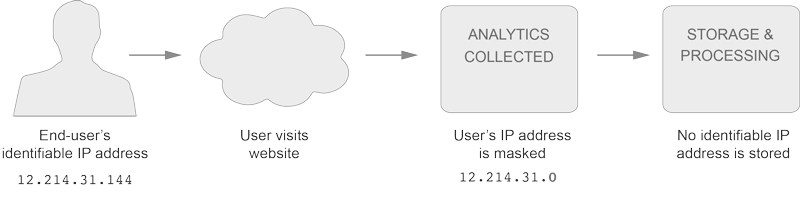
I have implemented IP Anonymization, simply put, the last three digits of your IP address are set to zeros in memory shortly after being sent to the Analytics Collection Network. The full IP address is never retained, or written to disk.

Cookies

This site also uses Cookies, find out more or manage them here.